
In a female body, there will be a pair of organs in the reproductive system called ovaries, which you can find in the pelvis, each on either sides of the uterus.
Once in a month, during your normal menstrual cycle, a cystic structure known as a follicle forms.
Actually, the follicle produces hormones such as estrogen and progesterone that helps release a mature egg from your ovary through the fallopian tube and finally to the uterus.
In some cases, the follicle persists to grow and turn into what is known as an ovarian cyst. The ovarian cyst is a sac with liquid, solid material or both contained in it, which you can find on the surface of the ovary or inside of it.
Ovarian cysts are quite common in all women who experience regular menstruation. It is found that ovarian cysts are also common in all pre-menopausal women, and up to 14.8% in postmenopausal women.
Mostly, you will not experience any symptoms of ovarian cysts as these are asymptomatic. Thus, you will not aware of the fact that you have a cyst. Most of the times, without any treatment, these ovarian cysts will disappear on its own after one or two menstrual cycles.
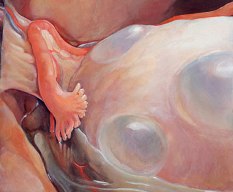
Actually, an ovarian cyst can be simple or complex. A simple cyst is a fluid-filled sac. Graafian follicular cysts and corpus luteum cysts are functional simple cysts.
However, a complex ovarian cyst consists of both fluid and solid contents. Dermoid cysts, endometriomas and cystadenomas are some of complex types of ovarian cysts.
Graafian follicular cysts:
A type of simple cyst occurs when ovulation doesn’t take place, and a follicle doesn’t break or release its egg instead grows till a cyst forms.
Usually, these cysts exhibit no symptoms and vanish by themselves within a few months. Ultrasound is the primary tool used to diagnose the follicular cyst.
Corpus luteum cyst:
Another type of ovarian cyst occurs after an egg released from a follicle. Thus the follicle becomes a corpus luteum. Usually, this cyst ruptures and disappears once if a pregnancy doesn’t occur. Even this is a fluid-filled cyst and usually causes no symptoms.
Dermoid cysts (teratomas):
A type of complex cysts having a very strange phenomenon with effectively structured sacs filled with pieces of bone, teeth, hair and skin. These are filled with solid structures, which mean they are not, technically, cysts; rather they can become malignant (cancerous).
Endometrial cysts:
This ovarian cyst is a condition where the lining of the womb (endometrium) starts growing in parts of the body other than the womb. These patches forms on the ovaries by creating cysts filled with old blood known as ‘chocolate cysts’.
These patches become encapsulated in a cyst will bleed during your periods. As there is no outlet for the bleeding, the cyst becomes larger. Even small cysts can rupture causing severe pain.
Cystadenoma cysts:
Normally, these ovarian cysts grow from cells on the exterior surface of the ovaries and up to a large size and are sometimes attached to the ovary by a stem. These cysts do not exhibit symptoms, but can twist on their stems and rupture. This can pain you extremely and requires emergency surgery.
Some helpful links to know more about Ovarian Cysts:
The Types of Ovarian Cysts That You Should Know About
Symptoms of an Ovarian Cyst and When They Are Important to Identify
What Are the Causes of Ovarian Cysts?
The Most Common Treatment for Ovarian Cysts
Signs of Ovarian Cysts and the Diagnosis
Symptoms of Ovarian Cyst to Lookout For
Natural Effective Ways To Treat Ovarian Cysts
More resources:
Safer Ways To Green-Up Your Menstrual Cycle





my family facing problem of cyst in her overy.
complex
My wife is diagnosed with hemorrhagic cyst in left ovary having size of 34X 33 mms with multiple thin internal septation. Her age is 32 and we are planning for 2nd baby. Is this cyst complex and what is its effect on pregnancy? Please advise.
Dear Vivek,
Your wife is sufferring from 3cms Cyst, which is not that much harmful, if the cyst is more than 5cms large then the doctors recommend surgery. otherwise they recommend Birth control pills or harmone pills, both are not good if you are planning for second baby. 3cms is not that large you can easy remove it by natural methods, you can find more Info here [http://ovariancystinfo.weebly.com/here] or try [here ]
Hi,
My wife (25 yrs, married for 2 years & yet to concieve) has been diagnosed with a cyst in right ovary (2.9cm x 2 cm) with little ovarian tissue peripherally. The report also mentioned of the possibility of its being a follicular one. Right ovary measures : 3.6 cm x 2.4 cm.
Please advise me on the follow ups to be done & possible treatment of the same.
Best regards.
HI,
my daughter of 18 yrs have been diagnosed with an ovarian cyst(functional cyst with internal echoes measuring 32.0mms)
plz advice me on to the follow ups and possible treatments
hi,
my daughter is 13 years old she has a cyst in her left ovary measure 2.15×1.56 cm plz advise me
hi,
i have been diagnosed with simple ovarian cysts. i have 2 on my right ovary and 1 on my left ovary. i was diagnosed on may 10,2009 because i went to the emergency room for severe abdominal pain and it was because one of the cysts on my right ovary collapsed and the other two cysts measured about 2 to 2 1/2 cm in size a piece.i went back 6 weeks later for another ultrasound on june 16,2009 and the ultrasound found i had 2 cysts one on each ovary measuring in at 4.1 cm a piece. I had to go back to the doctor on july 17,2009 because i was still bleeding from getting my menstral cycle may 25,2009 and was still bleeding until july,22,2009 and they also found that i have an enlarged uterus of 10 cm they did a biopsy and it came back normal i just don’t know what to do at this point i have been having abdominal pain since i gave birth to my second child in august of 2008. I am 26 years old and i just don’t know what to do and the doctors tell me they should go away on their own but it have been almost 1 year now and i’m so frustrated with the pain and irregular bleeding what do you think i should do? please comment back i would greatly appreciate it thanks.
Hi
i have recently found there is a chocolate cyst in my right ovary. (size 4.4 X 3.8cm). still i dint get pregnent. I got married 3 year back. Is it harmful for conceiving or it need any surgery? Doctor has recomended me to have Meprate (Medroxyprogesterone Acetate Tablet). Is it good for puncturing the cyst? or is it make any problem for conceiving? please reply me soon…..
hi,
i am 26 yr of age, married 2 yrs. back and i am suffering lower abdomen pain since a year. last july i was examined for appendices but no such thing found. April 2009 pain got severe and i got sonography done thrice in 3 days. out of which 2 were of opinion of chocolate cyst of size 28 X 22 X 25 mm and 1 was of follical cyst of 23 X 23 mm. July 2009 i got severe pain and when again sonography with TVS report done, i was operated through laproscopy for right ectopic pregnacny and was said that there is no endometriosis and no adhesions. And cyst was left as it is.
I am having severe pain but was asked to wait. i am also planning to conceive. would like to know from you whether cyst will hamper my conceiveing or can cause problem letter on.i am very much confused. should cyst remain in ovary or should it be removed before planning? Pls. help
i have an ovarian cyst that is 12cm x 11cm. Is this a dangerous size?
my wife is having 3*3cm and 5*4.5 cm cysts in the left and right overies. she had got removed the cyst in the left overy in jan 2008. the problem is nowadays she is feeling too much pain and discomfort-very difficult to do things in squat position, even thoough the cysts are not too big and are benign. biopsy and CA125 has been done.
Doctor has adviced hormon treatment for temporary halting of periods.
Please advice the line of treatment is ok and why there is such unbearable pain even when cysts are not so big. she has small multiple fibroids with bulky uterous also.
Please reply immediately
OVARIAN CYST BY MASTER ANEES
Ladies ko 2 ovary hoti hai left and right side/just beside womb in lower abdomen/ aurat ki ovary me eggs form aur mature hota hai har mahine in a tiny structre called a follicle/ jub ovary se egg release ho jati hai to ye follicle aik small structer me badal jate hain jise corpus luteum kahte hain/ ye hormones ko form karte hain pragnent hone k liye/
OVARY CYST-A cyst is a fluid filled sac/ Jinko period ho raha hai aur cyst problem hai usko functional cyst fault hai ye normal hota hai iske 2 prakar hain — 1-Flooicular cyst–A follicle can sometimes enlarge and fill with fluid. They can occur commonly in women who are receiving infertility treatment.2–Corpus luteum cysts. These occur when the corpus luteum fills with fluid or blood to form a cyst. (A blood filled cyst is sometimes called a haemorrhagic cyst.) ye dono cyst 6 cm tak badh sakte hain isko jyada treatment ki jarurat nahi healthy food khane se hormone lable sahi ho sakta hai aur fir khatm ho sakta hai/
agar birth controll pills se sahi nahi hota hai to surgical tarike se remove karna padta hai ayr jyadatar ye cancer nahi hota hai/ horomne function lable ovary se wrong ho jata hai aur ye cyst occur kar jata hai/ this is always painful lekin treatment is not painful ok/
i m 24 and 2 and a half years of married life ..never concieve..and now in this april i knoww that i have cys on my right ovary which is 10*7 cm and it ssolid cys..all doctor suggest me surgery but i m not going with it i have full faith on GOD..doctor recommend me dinocrine ..can i goes wid this ..and is that 100% surity that cys not create again..and is that i use cerophene or prolifen cap 50mg..for my conceiving with 12th day ultrasound and use gynocone inj…plz recommend me u advice is verry helpfull for me..thank u..
Hi,
I’m single lady from the Philippines. Today, after my first Ultrasound, I was diagnosed with endometriotic cyst on right ovary that measures 1.1 cm. As prescribed, I will undergo an injectable to remove it. The treatment will take 3 to 6 months. As my doctor said, I will feel like on my post menopause during the treatment. My question: Is there any alternative for treating this kind of cyst on the ovary?if there’s any,what are those?
Furthermore, this kind of sicknes was hereditary. These facts are accdg to my OB GYNE. Is this true?
Thanks for the help in advance!
I am 39 years old and have problems with my period for nearly a year. From having very light periods most of my life to now suddenly becoming extremely heavy, frequent and blood clots. Last December I was diagnosed with endimetrosis and ended up having a laproscopy done.Last month they found another cyst and I went for another laparsocopy and hysteroscopy – my consultant tells me am ok and all my tubes are in working order. However, am still concerned with the heavy periods and blod clots. Has anyone experience this and found a solution esp if you are trying to concieve?
I had a 10 cm cyst. on my right ovary by the time my insurance made me go worthless tests including a d and c.Withing 1 month it grew to 13 cms… Thank god it wasnt cancer!!! I lost half my right ovary…Two years later bleeding cyst left ovary,,,removed to find out also had cyst on right again…remove cyst and pain again why didnt they just remove it all???
i have a simple cyst 4.5cm. on my left ovary found on an ultrasound i had the ultrasound because the dr was not sure if he got enough for a pap because my cervix was closed i feel fine except when my husband and i get together i hurt for a day or so now. is all this realted. my pap came back satisfactory for evelation. edocervical cells/transformation zone componet present and neg. for intraepithelial lesion or maligancy i do not understand what all this means. i also have a discharge once in a while of clear fluid no smell. when i go to the bathroom all is fine there to please help me with answersthank-you
I am tamanna, suffering a overien chocolate cyst for 3 years.In first time i feel pain in my lower abdomen before the period start in every month.Then doctor prescribed for a operation because the cyst was large in size.after this laproscopy he prescribed Gonablock200 twice a day. because after one month my ultrasonography report was increasing overy size.Then I was changed my doctor.my preasent doctor preascribed Gynazol 100 for one tab in a day for 1 year.After starting the tab the cyst was decreasing in size but befor 4 monh he preascribed Trapic E tab when period start.(N.B. If i was take the Gynazol my period was regular but less then normal).Last day I got my ultrasound report then found the cyst is increasing, my overian size is 68.3 x 48 mm.My dctors suggest a moscobitch operation.Is this operation right?Because of this operation m i concive baby in future?is this is denger?pls give me the suggestion.I am unmarried, 23 years old.
One of my relations having cyst in right ovary. size is of 11.7×11.5cm, wall regular, single septation seen, thickness 2mm, small cystic focus of size 1x1cm seen within the cyst.
This is the USG scan report. Plz tell me whether this is an abnormal size or what is the scope of this cyst….Kindly reply as soon as possible. We are in need of a suggestion urgently….
kindly advise me i have been diagnosed with a simple left ovarian cyst with size 55mm * 42 mm,will this hinder me from conceiving ,i am 27yrs
I have a fibroid since I was 35 yrs it was 3 cm. Now it is 5 cm and this month I have a right ovarian cyst 4.4cm. It wasnt there 4 months ago. Now I have irregular bleeding. 2nd 3rd and 4th day 8 pads and 5th 6th normal stop on 7 or 8day. Again period came after 2 weeks. Since prepel (take specimen for testing)from uterus, period came on 15th april until now still bleeding. My last period was 26 March. Gov hospital done pap smear, prepel and CA125 test. CA125 normal but other result will be out in 2 months. Should I wait 2 months or immediately go for operation to remove my uterus and ovaries to prevent cancer? It is a liquid cyst. My private doc says if I have insurance, can do operation now but if no insurance wait for Goverment hospital result. Do you think I can wait anonther 2 months? If maglinant would it have spread all over my body?
hi,
i have a Endometrial cysts. size is of 4.9cm×3.8cm.,i am 27yrs.unmarried. back and i am suffering lower abdomen pain and fever since 3 year. it make any problem for conceiving? please reply me soon…..
im evelyn kindly advice me if i need to remove my cyst thru surgery operation i have a cyst on (may 10) 6.9 cm before my mensruation then after that my doctor take me an transvaginal ultrasound and decreasing 5.8 cm,now she take me a CA-125 my result i think is 45 like that…now on monday May 31 2010 i take for other test that is MRI..can you advice me because i want to remove my cyst but my ob told me why you remove..I want to know it is possible not to remove or it is not dangerous for me..thanks
hi, im 20 yrs old and i got Dx with an ovarian cyst 2.4cm i wanted to get pregnant now but i am not sure if this will affetct me getting pregnant can you please let me know if il be hard for me to get pregnant:(