


Archive for the 'Breast Cancer' Category


The Impact Of Alcohol Consumption In The Development Of Women’s Breast Cancer!

Monday 15 September 2008

alcohol consumptionWe all know, for almost a decade, the effects of alcohol. In moderation, alcohol is good for heart.

But, now, new researches are showing a strong relation between alcohol and breast cancer, an important health concern among women.

It reports that alcohol consumption is directly related to the occurrence of breast cancer.

So, women who drink alcohol are at greater risk of developing breast cancer. Moreover, the risk is directly proportional to the alcohol consumption quantity.

In other words, an increase in the alcohol consumption quantity increases the risk of breast cancer development.

Scientists have recently estimated that the woman’s risk of developing breast cancer rises by six percent for every additional amount of alcohol consumption on a standard daily basis.

The recent evidence recommends that all types of alcohol–wine, beer and whisky—increases the risk of breast cancer.

So, remember that the type of alcohol–wine, beer or whisky—you take makes no difference, it differs only with the alcohol consumption quantity.

The incidence of breast cancer is more among post-menopausal women, who consume alcohol excessively. It is because alcohol is a major risk factor for the development of most common form of breast cancer.


Stress May Increase The Risk Of Breast Cancer

Saturday 13 September 2008

The results of a new study support an interaction between severe life events, psychological distress, and breast cancer.

“Young women who are exposed to severe life events more than once should be considered as a risk group for breast cancer and treated accordingly,” Dr. Ronit Peled said.

Peled, from Ben-Gurion University of the Negev, Beer Sheva, Israel, and colleagues studied 255 women younger than 45 years old who had been diagnosed with breast cancer, and compared them with 367 healthy women of a similar age.

The team evaluated interactions between breast cancer and severe life events — such as the loss of a parent, close relative or spouse, or the divorce of parents before age 20 — and mild to moderate life events — e.g., separation from a spouse, loss of a job, an economic crisis, or severe illness in a close relative.

After correcting for potentially influential variables, their analysis revealed a positive association between exposure to more than one adverse life event and breast cancer.

For these women, the risk of breast cancer was increased by 62 percent. “It wasn’t enough to be exposed to one life event, a woman had to be exposed to more than one event,” Peled said.


New Target For Fight Against Common Type Of Breast Cancer: Brk

Wednesday 27 August 2008

A new promising enzyme target for a specific type of breast cancer, Brk, has been identified in research.

In a specific subset of breast cancer patients, the tumor cells produce high levels of the protein ErbB2 (also called HER2) which pushes the cells to proliferate without limit, a characteristic common of all cancers.

Approximately one in four patients are in this group, and their clinical prognoses are considerably worse than other patients.

While Herceptin and Lapatinib, concomitantly administered with other chemotherapic agents, have improved the prognosis for many of these patients, there is significant potential for development in this area.

In particular, they are able to suppress ErbB2, but are not effective against all tumors that secrete it. Additionally, when patients’ tumors do respond, they usually become resistant over time.

According to the authors of this study, this suggested that another element might factor into the progression of these tumors.

According to the authors “The limited success of existing therapy suggested to us that factors besides ErbB2, or proteins that collude with ErbB2, might nullify the effects of Herceptin and Lapatinib.”


Those At Risk For Breast Cancer Are Having Mastectomies

Wednesday 20 August 2008

mastectomiesWomen at elevated risk for breast cancer - or a recurrence of the disease - increasingly are choosing double mastectomies as a protective measure against cancer’s rebound, doctors said.

Emmy Award-winning actress Christina Applegate, who underwent a mastectomy for breast cancer earlier this month, announced yesterday that she also chose a preventive mastectomy, commonly called a prophylactic mastectomy, on the opposite side.

Applegate, 36, said she carries the BRCA 1 gene mutation. Over a lifetime, BRCA 1 can increase the risk of the disease by as much as 85 percent.

She said her choice of a prophylactic mastectomy was to pre-empt the possibility of developing breast cancer in the future.

Genomic testing in recent years not only allows women to learn whether they’re carriers of a mutation, but a positive test can pave the way for making an excruciatingly difficult decision, said Dr. Brian O’Hea, medical director of the Carol M. Baldwin Breast Care Center.

In addition to BRCA 1, the gene carried by Applegate, another, BRCA 2, also can increase the risk of breast cancer.

Carriers of BRCA 1 and 2 also have elevated ovarian cancer risks. The genes can be transmitted by either parent, and are a leading cause of breast cancer that occurs before the age of 40.


Five Breast Cancer Myths

Tuesday 5 August 2008

breast cancerWhen someone well-known such as Christina Applegate is diagnosed with breast cancer, many adult women become concerned as to what the future holds for them.

While it’s true that 1 out of 8 American women will be diagnosed with breast cancer at some point in her lifetime, there are also a lot of misconceptions about the disease floating around.

Although Applegate is just 36 years old, the fact remains that breast cancer is more likely to strike women over the age of 50.

Still, many women under the age of 40 may now be tempted to run out and demand mammograms.

But mammograms are ineffective for most young women, told Dr. Diana Zuckerman, president of the National Research Center for Women & Families.

“Young women’s breasts are dense and if they get mammograms, their breasts show up very white on mammograms and cancer shows up as white,” she said.

“But, as women get older, their breasts are less dense and show up gray on a mammogram, which makes it easy to identify the white cancer.

If there is a family history, and women are worried, they can start earlier and in this case a digital mammography may work better than a traditional mammography.”


Breast Cancer Mortality Increases With High Body Mass Index

Saturday 26 July 2008

body mass indexA higher body mass index (BMI) is associated with lower survival rates in women with breast cancer, according to a report in the Journal of Clinical Oncology.

BMI is the ratio of weight to height, which is often used to see if a patient’s weight is outside normal parameters.

“We have found strong evidence that high BMI and a recent pregnancy are associated with a poorer prognosis after a diagnosis of breast cancer,” Dr. Gillian C. Barnett told Reuters Health. “Our study suggests that advice on weight loss should be given to all obese patients with breast cancer.”

Dr. Barnett from Addenbrooke’s Hospital, Cambridge, UK and colleagues investigated the impact of established risk factors for incident breast cancer on overall survival after a diagnosis of breast cancer, using data from the Studies of Epidemiology and Risk Factors in Cancer Heredity.

Women with the highest BMIs were 52 percent more likely to die than women with the lowest BMIs, the investigators report.

“The Women’s Interventional Nutritional Study reported improved event-free survival in women randomly assigned to a reduced fat diet (associated with weight loss),” Barnett pointed out. “Further definitive clinical weight loss intervention trials in breast cancer populations are required to further clarify the relationship between breast cancer mortality and BMI.”


Treating Rare Breast Cancer With Radiation Therapy May Lower Recurrence Rate

Saturday 12 July 2008

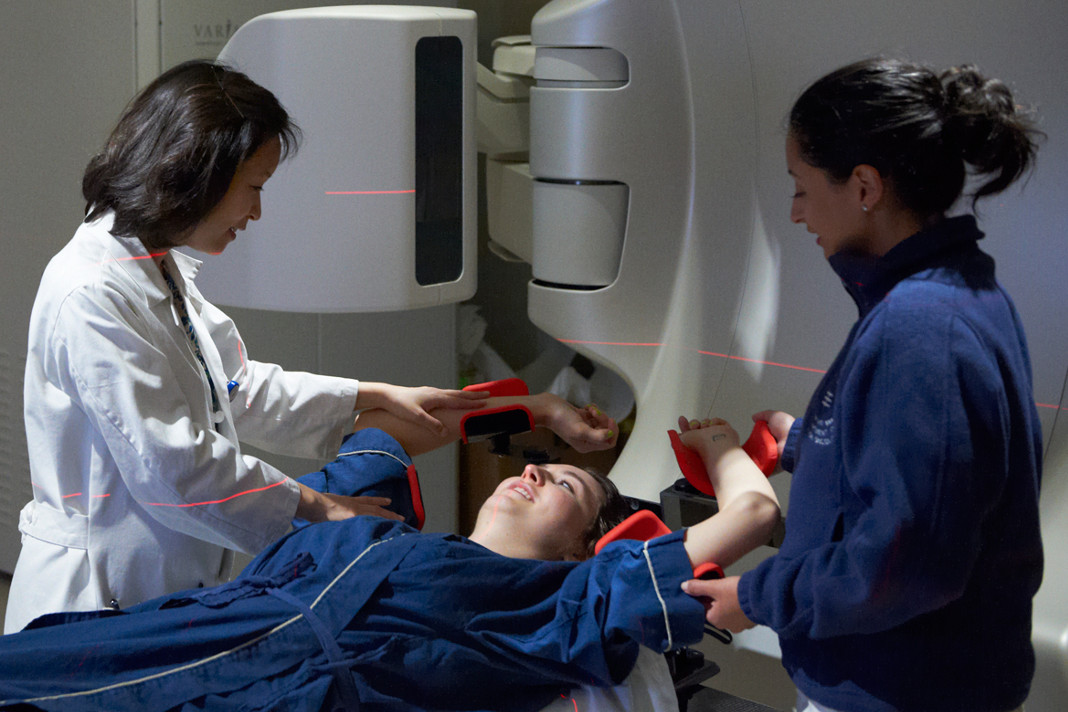
radiation therapyAccording to a study, patients with a rare type of breast cancer may benefit from receiving radiation therapy in addition to surgery to prevent recurrence.

Phyllodes tumors are rare breast tumors that develop in the connective tissue of the breast, as opposed to more common carcinomas, which develop in the ducts or lobules of the breast.

Most patients are treated for phyllodes tumors with either a lumpectomy or mastectomy, with only a small fraction of patients receiving radiation therapy.

Traditionally, adjuvant radiation therapy is recommended for cancer patients with local recurrence risks of 15 percent or greater, but the value of adjuvant radiation therapy has not been extensively studied for phyllodes tumors because they are so rare.

Researchers sought to determine the local recurrence rates of phyllodes tumors based on tumor size and the type of surgery performed and whether adjuvant radiation therapy should be considered as a treatment for some phyllodes tumor patients to reduce their local recurrence rate.

“Typically these tumors are treated well by surgery alone. However, local recurrences are not uncommon,” Richard Pezner, M.D., lead author of the study and a radiation oncologist at City of Hope National Medical Center in Duarte, Calif., said.


Lipstick Causes Breast Cancer In Females

Thursday 12 June 2008

lipstick

Could lipstick give you breast cancer?

Chemicals found in lipstick and nail varnish could trigger breast cancer, scientists warned yesterday.

A study has shown that butyl benzyl phthalate, or BBP, can interfere with the healthy development of breast tissue.

The man-made substance is part of the phthalate family of chemicals, which mimic the female sex hormone oestrogen.

Environmental campaigners yesterday called for it to be banned in the cosmetic industry, where it is used to make products glossy.

According to Dr. Russo, the head of researchers, the toxin chemicals in the cosmetics trigger unnatural tissues to cause breast cancer as (BBP) is most likely to be used in the cosmetics industry to make products glossy, which is a toxin that hampers in developing natural healthy breast tissues.

In Great Britain, 90% females suffering from breast cancer were using lip sticks and applied many coats of it every day to transform a dull face into wow face. After research work and publishing report, they left lip stick use. Similarly based on Dr. Russo’s report USA females are reluctant to use lipstick and prefer dull face without lip stick since life is much more important than a wow face of shining lip stick.


Next Posts »» «« Previous Posts